In brief: AI systems increasingly answer B2B research questions from third-party sources – trade media, analyst commentary, interviews and press coverage – rather than from your own website. That is precisely why press work has become the strongest lever for AI visibility. The good news: what language models reward is essentially what good PR has always delivered. This does not require a new craft, just a few targeted additions.
Why is everyone suddenly talking about GEO and AEO?
Because the research chain is breaking. The classic route – search query, results list, click through to a website – is increasingly being replaced by a single question put to ChatGPT, Perplexity, Gemini or Google AI Mode. The answer arrives pre-summarised, often without anyone ever opening your site.
The pressure to act is widely recognised; execution lags behind. In a recent survey of B2B tech companies across the DACH region, only one in 25 reported strong visibility in AI systems. The main reason is rarely a lack of understanding – it is a lack of time in the day-to-day marketing routine.
Two terms have established themselves as the response:
- AEO (Answer Engine Optimisation) targets the one authoritative answer: product comparisons, how-to questions, definitions. The aim is to be surfaced as the source of the direct answer.
- GEO (Generative Engine Optimisation) targets presence in broader generative contexts: market overviews, vendor lists, trend assessments. Anyone who wants to be named as a category player or thought leader needs GEO.
For most B2B tech vendors, GEO is the more relevant lever – because the decisive question is rarely “What does product X cost?” but “Which vendors should I be looking at for Y?”.
What does PR have to do with it?
A great deal – because AI systems weight mentions on trustworthy third-party sites heavily. When a language model answers a question about your category, it draws disproportionately on trade publications, comparison pages, reviews and editorial coverage, far more than on your own corporate website. Self-description counts for little; external validation counts for a lot.
This shifts the role of PR. It is no longer merely a reach and reputation channel, but the raw-material supplier for the very sources AI systems build their answers from. Every trade article, every expert quote, every picked-up announcement is a potential citation in training and retrieval material.
The instruments that matter here: media relations and pitching, press releases with targeted distribution, thought leadership pieces and bylined articles, expert commentary on current developments, case studies and white papers, interviews, podcasts and speaking slots, plus owned content on your website and social media. The press release is one tool among many – but a particularly GEO-friendly one, because it is fact-dense, structured and, at best, widely mirrored.
You don’t have to reinvent the wheel
GEO-oriented PR differs remarkably little in substance from well-executed traditional PR. The reason becomes obvious once you place the criteria side by side:
| What has always defined good PR | What AI systems reward |
|---|---|
| Genuine news value instead of self-congratulation | Substantial, information-dense content |
| Solid facts and figures | Citable, verifiable data points |
| Credible third-party placement in trade media | Mentions on trustworthy domains |
| Precise targeting instead of scattergun distribution | Thematically relevant sources |
| Clear structure, comprehensible language | Extractable, unambiguous statements |
| Consistent core messages | Consistent entities and factual record |
Put differently: the mass press release without news value, blasted blindly across a 5,000-address distribution list, was never good PR. It is simply more obviously ineffective now.
Anyone already working to a decent standard has therefore done most of the work. What remains are targeted additions. That’s my “Best Practice Plus” Approach.
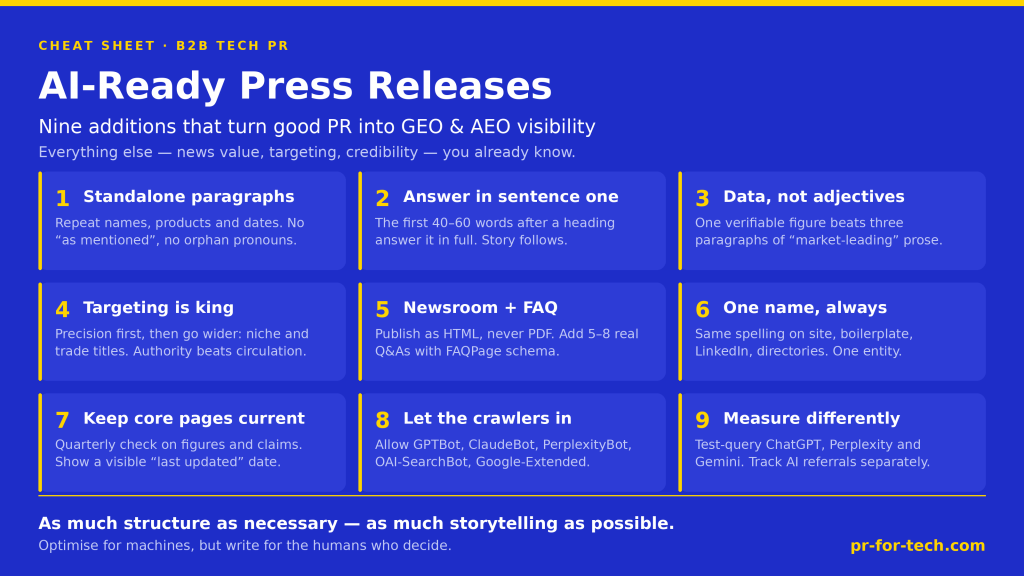
The tips: how to make your press Releases AI-ready
Tip 1: Write paragraphs that stand on their own
AI systems rarely extract whole texts; they extract individual passages. A paragraph that makes no sense without the one before it simply will not be cited.
In practice: avoid back-references such as “as mentioned” or “the company” without naming it. Repeat company names, product names and time references in every relevant paragraph. It reads marginally more repetitive – and it is decisive for extraction.
Tip 2: Answer the question in the first two sentences
Retrieval systems assess relevance largely on how a section opens. The first 40 to 60 words after a heading should answer the question in full – the elaboration, the quote and the colour come afterwards.
In practice: the opening paragraph of your press release should contain what, who, when, where and why in complete sentences. No narrative arc, no scene-setting about market trends. The classic five-Ws rule of the PR craft happens to be the best GEO rule as well.
Tip 3: Supply your own numbers instead of adjectives
“Market-leading”, “innovative” and “ground-breaking” are worthless to language models – they are neither verifiable nor citable. Proprietary data is the single strongest reason for an AI system to cite you rather than someone else.
In practice: small in-house surveys, anonymised usage data from your own product, customer polls, benchmark results. One solid data point – “42 per cent of logistics companies surveyed use X” – travels further than three paragraphs of marketing prose. Data storytelling was the most efficient PR discipline long before AI search arrived.
Tip 4: Distribute precisely – but more broadly than before
Precise targeting remains correct. What has changed is that smaller trade portals, industry newsletters and niche outlets also contribute to AI visibility, provided they are thematically relevant and get crawled. Focusing solely on top-tier titles now falls short.
In practice: add ten to twenty closely relevant trade and niche sources to your A-list. The criterion is not circulation but topical authority within your segment.
Tip 5: Newsroom plus FAQ – the most important on-page tip
Publish every press release in your own indexable newsroom on your company domain – as HTML, not as a PDF download. And add a short FAQ block underneath.
In practice: below the body copy, place five to eight genuine questions with concise answers – the questions journalists and prospects would actually ask: “What exactly does the product do?”, “When will it be available?”, “Who are the investors?”, “What does it cost?”. Mark them up with FAQPage schema. That way the release itself remains a narrated story with quotes, while the hard facts sit alongside it in machine-readable chunks.
Tip 6: Always name yourself the same way
Language models work with entities. If your company appears sometimes as “Sample GmbH”, sometimes as “Sample Technologies” and sometimes as “SampleTech”, your reputation fragments across three weak records instead of consolidating into one strong one.
In practice: define a binding spelling for your company name, product names, personal names and job titles – and apply it consistently across your website, boilerplate, LinkedIn, Wikipedia entry, directories and every press release. The boilerplate at the foot of a release matters more than its reputation suggests: it is the most compact entity description you put into circulation.
Tip 7: Keep core content current
Outdated figures on your most important pages lead AI systems to circulate incorrect or superseded claims about you – and to favour other, fresher sources.
In practice: review your central pages – About, product pages, glossary, cornerstone articles – quarterly for headcount, customer numbers, funding status and product scope. Add a visible “last updated” date.
Tip 8: Open the door to AI crawlers
On your website, in this case typically in the “news” section, check your robots.txt for explicit rules covering GPTBot, ClaudeBot, PerplexityBot, OAI-SearchBot and Google-Extended. Blocking these crawlers means you simply cannot be cited in the corresponding systems.
In practice: structured mark-up via Schema.org is worth adding as well – Organisation, Article, FAQPage, Product. An llms.txt file takes little effort to create, but do not overestimate it: as things stand, the major AI providers rarely fetch the file and crawl HTML directly instead. Hygiene, not strategy.
Tip 9: Measure differently
Reach, clippings and backlinks remain relevant – but they now tell only half the story.
In practice: extend your reporting with regular test queries in ChatGPT, Perplexity, Gemini and Google AI Mode, using the buying questions your audience actually asks. Are you named? Backed by which sources? Alongside which competitors? Also track referral traffic from AI systems separately in your analytics.
The most important guardrail: do not over-optimise
Every tip above is a means to an end – not the end itself. Write solely for crawlers and you will produce releases no editor picks up and no reader finishes. And with that, AI visibility collapses too, because without editorial pick-up there are no third-party sources for a language model to cite.
The formula: as much structure as necessary, as much storytelling as possible. News value still determines whether a release has any effect at all. Structure and machine readability ensure that effect also lands where research now happens.
A simple test: read your release aloud. Does it sound like something a human wrote and a human would want to read? Then the balance is right.
The overlooked winner: the newsroom on the other side
Well-structured, fact-rich press work benefits more than just you – it benefits the journalists you work with. A release with clear facts, solid figures, correct names and quotable statements saves research time. And the resulting article is itself better structured and more fact-dense, making it easier for AI systems to find and cite.
That is an argument you can make openly in conversations with editorial teams: you are supplying material that is not only quick to process but also strengthens the AI visibility of the resulting piece. At a time when media houses are fighting for reach in generative systems too, that is a real value proposition – and a relationship argument that extends well beyond the individual placement.
Conclusion
GEO and AEO do not require a new PR craft. They require consistently good PR craft – supplemented by structure, verifiable facts, consistent entities, a broader choice of sources and new metrics. Anyone who already takes press work seriously does not need to relearn, only to sharpen.
And anyone who has treated it as a text-block exercise is simply finding out faster that it never worked.
Frequently asked questions about GEO, AEO and press work
What is the difference between GEO and AEO?
AEO (Answer Engine Optimisation) aims to have you surfaced as the source of the one direct answer – for definitions, how-to questions or product comparisons. GEO (Generative Engine Optimisation) aims at presence in broader generative contexts such as market overviews, vendor lists and trend assessments. For B2B tech vendors, GEO is usually the more relevant lever.
Do press releases improve visibility in ChatGPT and Perplexity?
Yes, indirectly and effectively. AI systems weight mentions on trustworthy third-party sites heavily. A press release picked up by trade media creates exactly those sources. The release sitting on a distribution portal alone is considerably weaker than the editorial coverage it generates.
Should a B2B company run a separate, AI-optimised version of its website?
No. Serving different content to bots and humans counts as cloaking and is penalised by both search and AI systems. The sensible approach is an additional structural layer over the same content: schema mark-up, question-based subheadings, FAQ blocks and glossary pages.
Where should I publish press releases for maximum AI visibility?
In your own indexable newsroom on your company domain – as an HTML page, not a PDF – combined with targeted distribution to thematically relevant trade and niche media. An FAQ block below the release increases the extractability of the key facts.
Do I need an llms.txt file?
It does no harm and takes little time to set up, but as things stand it is not a significant lever: the major AI crawlers largely do not fetch the file and process HTML directly instead. Explicit permissions for AI crawlers in robots.txt, clean schema mark-up and third-party mentions matter considerably more.
How do I measure AI visibility?
Through regular test queries in ChatGPT, Perplexity, Gemini and Google AI Mode using your audience’s typical research questions – checking whether you are named, which sources support the mention, and which competitors appear alongside you. In addition, report referral traffic from AI systems separately in your web analytics.
Want to know where your company stands in AI answers today – and what your press work can do about it? Get in touch.
About the author
I am Thomas Konrad, a freelance tech PR and content marketing specialist. I have been supporting tech companies and start-ups with their communications for 25 years. I bring your products, innovations, people and brands to the global stage, using AI wisely and responsibly.