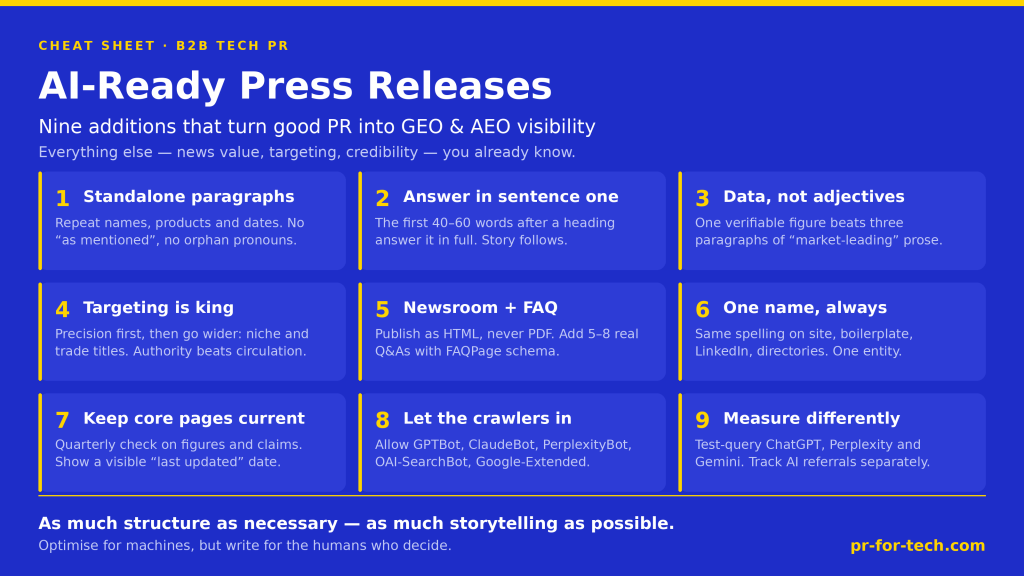
Cheat sheet: nine additions that make B2B tech press releases visible in AI search.

In brief: AI systems increasingly answer B2B research questions from third-party sources – trade media, analyst commentary, interviews and press coverage – rather than from your own website. That is precisely why press work has become the strongest lever for AI visibility. The good news: what language models reward is essentially what good PR has always delivered. This does not require a new craft, just a few targeted additions.


Why is everyone suddenly talking about GEO and AEO?

Because the research chain is breaking. The classic route – search query, results list, click through to a website – is increasingly being replaced by a single question put to ChatGPT, Perplexity, Gemini or Google AI Mode. The answer arrives pre-summarised, often without anyone ever opening your site.

The pressure to act is widely recognised; execution lags behind. In a recent survey of B2B tech companies across the DACH region, only one in 25 reported strong visibility in AI systems. The main reason is rarely a lack of understanding – it is a lack of time in the day-to-day marketing routine.

Two terms have established themselves as the response:

  • AEO (Answer Engine Optimisation) targets the one authoritative answer: product comparisons, how-to questions, definitions. The aim is to be surfaced as the source of the direct answer.
  • GEO (Generative Engine Optimisation) targets presence in broader generative contexts: market overviews, vendor lists, trend assessments. Anyone who wants to be named as a category player or thought leader needs GEO.

For most B2B tech vendors, GEO is the more relevant lever – because the decisive question is rarely “What does product X cost?” but “Which vendors should I be looking at for Y?”.


What does PR have to do with it?

A great deal – because AI systems weight mentions on trustworthy third-party sites heavily. When a language model answers a question about your category, it draws disproportionately on trade publications, comparison pages, reviews and editorial coverage, far more than on your own corporate website. Self-description counts for little; external validation counts for a lot.

This shifts the role of PR. It is no longer merely a reach and reputation channel, but the raw-material supplier for the very sources AI systems build their answers from. Every trade article, every expert quote, every picked-up announcement is a potential citation in training and retrieval material.

The instruments that matter here: media relations and pitching, press releases with targeted distribution, thought leadership pieces and bylined articles, expert commentary on current developments, case studies and white papers, interviews, podcasts and speaking slots, plus owned content on your website and social media. The press release is one tool among many – but a particularly GEO-friendly one, because it is fact-dense, structured and, at best, widely mirrored.


You don’t have to reinvent the wheel

GEO-oriented PR differs remarkably little in substance from well-executed traditional PR. The reason becomes obvious once you place the criteria side by side:

What has always defined good PRWhat AI systems reward
Genuine news value instead of self-congratulationSubstantial, information-dense content
Solid facts and figuresCitable, verifiable data points
Credible third-party placement in trade mediaMentions on trustworthy domains
Precise targeting instead of scattergun distributionThematically relevant sources
Clear structure, comprehensible languageExtractable, unambiguous statements
Consistent core messagesConsistent entities and factual record

Put differently: the mass press release without news value, blasted blindly across a 5,000-address distribution list, was never good PR. It is simply more obviously ineffective now.

Anyone already working to a decent standard has therefore done most of the work. What remains are targeted additions. That’s my “Best Practice Plus” Approach.


The tips: how to make your press Releases AI-ready

Tip 1: Write paragraphs that stand on their own

AI systems rarely extract whole texts; they extract individual passages. A paragraph that makes no sense without the one before it simply will not be cited.

In practice: avoid back-references such as “as mentioned” or “the company” without naming it. Repeat company names, product names and time references in every relevant paragraph. It reads marginally more repetitive – and it is decisive for extraction.

Tip 2: Answer the question in the first two sentences

Retrieval systems assess relevance largely on how a section opens. The first 40 to 60 words after a heading should answer the question in full – the elaboration, the quote and the colour come afterwards.

In practice: the opening paragraph of your press release should contain what, who, when, where and why in complete sentences. No narrative arc, no scene-setting about market trends. The classic five-Ws rule of the PR craft happens to be the best GEO rule as well.

Tip 3: Supply your own numbers instead of adjectives

“Market-leading”, “innovative” and “ground-breaking” are worthless to language models – they are neither verifiable nor citable. Proprietary data is the single strongest reason for an AI system to cite you rather than someone else.

In practice: small in-house surveys, anonymised usage data from your own product, customer polls, benchmark results. One solid data point – “42 per cent of logistics companies surveyed use X” – travels further than three paragraphs of marketing prose. Data storytelling was the most efficient PR discipline long before AI search arrived.

Tip 4: Distribute precisely – but more broadly than before

Precise targeting remains correct. What has changed is that smaller trade portals, industry newsletters and niche outlets also contribute to AI visibility, provided they are thematically relevant and get crawled. Focusing solely on top-tier titles now falls short.

In practice: add ten to twenty closely relevant trade and niche sources to your A-list. The criterion is not circulation but topical authority within your segment.

Tip 5: Newsroom plus FAQ – the most important on-page tip

Publish every press release in your own indexable newsroom on your company domain – as HTML, not as a PDF download. And add a short FAQ block underneath.

In practice: below the body copy, place five to eight genuine questions with concise answers – the questions journalists and prospects would actually ask: “What exactly does the product do?”, “When will it be available?”, “Who are the investors?”, “What does it cost?”. Mark them up with FAQPage schema. That way the release itself remains a narrated story with quotes, while the hard facts sit alongside it in machine-readable chunks.

Tip 6: Always name yourself the same way

Language models work with entities. If your company appears sometimes as “Sample GmbH”, sometimes as “Sample Technologies” and sometimes as “SampleTech”, your reputation fragments across three weak records instead of consolidating into one strong one.

In practice: define a binding spelling for your company name, product names, personal names and job titles – and apply it consistently across your website, boilerplate, LinkedIn, Wikipedia entry, directories and every press release. The boilerplate at the foot of a release matters more than its reputation suggests: it is the most compact entity description you put into circulation.

Tip 7: Keep core content current

Outdated figures on your most important pages lead AI systems to circulate incorrect or superseded claims about you – and to favour other, fresher sources.

In practice: review your central pages – About, product pages, glossary, cornerstone articles – quarterly for headcount, customer numbers, funding status and product scope. Add a visible “last updated” date.

Tip 8: Open the door to AI crawlers

In practice: structured mark-up via Schema.org is worth adding as well – Organisation, Article, FAQPage, Product. An llms.txt file takes little effort to create, but do not overestimate it: as things stand, the major AI providers rarely fetch the file and crawl HTML directly instead. Hygiene, not strategy.

Tip 9: Measure differently

Reach, clippings and backlinks remain relevant – but they now tell only half the story.

In practice: extend your reporting with regular test queries in ChatGPT, Perplexity, Gemini and Google AI Mode, using the buying questions your audience actually asks. Are you named? Backed by which sources? Alongside which competitors? Also track referral traffic from AI systems separately in your analytics.


The most important guardrail: do not over-optimise

Every tip above is a means to an end – not the end itself. Write solely for crawlers and you will produce releases no editor picks up and no reader finishes. And with that, AI visibility collapses too, because without editorial pick-up there are no third-party sources for a language model to cite.

The formula: as much structure as necessary, as much storytelling as possible. News value still determines whether a release has any effect at all. Structure and machine readability ensure that effect also lands where research now happens.

A simple test: read your release aloud. Does it sound like something a human wrote and a human would want to read? Then the balance is right.


The overlooked winner: the newsroom on the other side

Well-structured, fact-rich press work benefits more than just you – it benefits the journalists you work with. A release with clear facts, solid figures, correct names and quotable statements saves research time. And the resulting article is itself better structured and more fact-dense, making it easier for AI systems to find and cite.

That is an argument you can make openly in conversations with editorial teams: you are supplying material that is not only quick to process but also strengthens the AI visibility of the resulting piece. At a time when media houses are fighting for reach in generative systems too, that is a real value proposition – and a relationship argument that extends well beyond the individual placement.


Conclusion

GEO and AEO do not require a new PR craft. They require consistently good PR craft – supplemented by structure, verifiable facts, consistent entities, a broader choice of sources and new metrics. Anyone who already takes press work seriously does not need to relearn, only to sharpen.

And anyone who has treated it as a text-block exercise is simply finding out faster that it never worked.


Frequently asked questions about GEO, AEO and press work

What is the difference between GEO and AEO?

AEO (Answer Engine Optimisation) aims to have you surfaced as the source of the one direct answer – for definitions, how-to questions or product comparisons. GEO (Generative Engine Optimisation) aims at presence in broader generative contexts such as market overviews, vendor lists and trend assessments. For B2B tech vendors, GEO is usually the more relevant lever.

Do press releases improve visibility in ChatGPT and Perplexity?

Yes, indirectly and effectively. AI systems weight mentions on trustworthy third-party sites heavily. A press release picked up by trade media creates exactly those sources. The release sitting on a distribution portal alone is considerably weaker than the editorial coverage it generates.

Should a B2B company run a separate, AI-optimised version of its website?

No. Serving different content to bots and humans counts as cloaking and is penalised by both search and AI systems. The sensible approach is an additional structural layer over the same content: schema mark-up, question-based subheadings, FAQ blocks and glossary pages.

Where should I publish press releases for maximum AI visibility?

In your own indexable newsroom on your company domain – as an HTML page, not a PDF – combined with targeted distribution to thematically relevant trade and niche media. An FAQ block below the release increases the extractability of the key facts.

Do I need an llms.txt file?

It does no harm and takes little time to set up, but as things stand it is not a significant lever: the major AI crawlers largely do not fetch the file and process HTML directly instead. Explicit permissions for AI crawlers in robots.txt, clean schema mark-up and third-party mentions matter considerably more.

How do I measure AI visibility?

Through regular test queries in ChatGPT, Perplexity, Gemini and Google AI Mode using your audience’s typical research questions – checking whether you are named, which sources support the mention, and which competitors appear alongside you. In addition, report referral traffic from AI systems separately in your web analytics.

Want to know where your company stands in AI answers today – and what your press work can do about it? Get in touch.


About the author

I am Thomas Konrad, a freelance tech PR and content marketing specialist. I have been supporting tech companies and start-ups with their communications for 25 years. I bring your products, innovations, people and brands to the global stage, using AI wisely and responsibly.

PR & Affilate Marketing


PR freelancers and agencies need content commerce skills

You’ve probably noticed, especially around seasonal shopping peaks like Black Week, back-to-school or Christmas, how full DACH media are of price comparisons, tests, best-of lists and “top deals” – and how often these pieces lead straight into the shopping basket.

Exactly these peak phases are the stress test for a model that actually runs all year round: content commerce, in other words affiliate marketing in editorial environments.

Whether you like it or not:

For B2C providers – especially in consumer tech – affiliate in media is no longer optional. It’s a necessity if you want to be present at the decisive moment in the purchase decision.

And PR is the performance catalyst that decides whether your products show up in exactly these environments.

The numbers show how relevant this has become: the global affiliate market is estimated at around 18.5 billion US dollars in 2024 and is expected to grow to over 31 billion US dollars by 2031 (Affiliate Marketing Industry Statistics 2025). Studies by Rakuten/Forrester also show that 81% of brands use an affiliate programme and 84% of publishers are involved in affiliate marketing (Rakuten/Forrester study via OptinMonster).

In other words: a large part of today’s customer journey takes place in environments that are heavily refinanced via affiliate models – and you need to be visible there with your products.

Even more important in terms of visibility: commerce content – such as price comparisons, bargain alerts, best-of lists and product tests – answers extremely concrete buying questions. These are exactly the type of pieces people search for when they’re just one step away from a purchase – and they’re also ideal feeding material for search engines and AI assistants. I’ll go into more detail on this link between content commerce, SEO and LLMs further down.


What Is Content Commerce / Affiliate Marketing in Media?

In the media context, affiliate marketing – often also called content commerce – refers to a performance-based remuneration model:

  • The editorial team (affiliate/publisher) recommends or tests a product.
  • Affiliate links to the provider’s shop (merchant) are embedded in the article, test or guide.
  • If a reader clicks the link and buys, the medium receives a commission, usually as a percentage of the net basket value.

This creates a win–win model:

  • Media can monetise their content directly – important in times of declining traditional advertising revenues.
  • Retailers only pay when there is success (sale or qualified lead).
  • Readers get a curated overview: best-of lists, tests and guides instead of anonymous product listings.

One important point: in many statistics, retail accounts for over 40% of affiliate revenues. That shows how central B2C products – especially tech, lifestyle and general interest – are for this channel.


How Consumer Tech, General-Interest and Lifestyle Media Use Commerce Content (Affiliate)

Within media houses, the interplay between editorial content such as tests, best-of lists or guides and the partner links behind them is usually called commerce content or content commerce – technically it is classic affiliate marketing. Whenever we talk below about tests, buying guides or shopping features, we are essentially talking about commerce content that is monetised via affiliate models.

1. Consumer Tech: Tests, Benchmarks, Best-of Lists

In consumer tech media (e.g. CHIP, COMPUTER BILD, gaming and photo portals), affiliate has long been standard.

Typical formats:

  • “The best smartphones 2025”
  • “Noise-cancelling headphones on test”
  • “The best monitors for the home office”
  • “Gaming laptops compared”

The mechanics:

  1. Products are tested, measured and compared.
  2. Tables and product boxes contain purchase recommendations (“Our test winner”, “Best value for money”).
  3. Behind these are affiliate links to retailers such as Amazon, MediaMarkt, Saturn, manufacturer shops, etc.

What this means for you as a provider:
Tests and best-of lists are now reach, reputation lever and sales channel all at once.

2. General-Interest Portals: Buying Advice as Its Own Desk

Large general-interest portals in DACH – such as BILD, t-online, FOCUS online, SPIEGEL.de, FAZ.net – have built their own shopping or buying-advice desks:

  • Shopping desks at tabloid and news portals – dedicated editors whose KPIs are directly linked to clicks, conversion and revenue.
  • Test centres & labs at tech and general-interest brands – e.g. extensive test labs for electronics, household and leisure; the expensive tests are refinanced via affiliate.
  • Buying-advice teams at quality media – specialised teams that know which product categories and price ranges convert well.

Here you see formats such as:

  • “Gift ideas for tech fans”
  • “The best coffee machines for families”
  • “Affordable tablets for uni”
  • “Smart home appliances that are genuinely worth it”

Almost always with clearly labelled affiliate links (“To the shop”, basket icons, partner notes).

3. Lifestyle & Inspiration: Storytelling that Leads Straight to a Purchase

The picture is similar in the lifestyle segment (fashion, beauty, interiors, travel, food):

  • “Summer trainers 2025”
  • “The best air fryers reviewed”
  • “Home-office setups for small flats”
  • “Beauty gadgets TikTok loves”

Again, the pattern is:
The editorial team curates products, shows combinations and gives concrete buying recommendations – with affiliate links to shops such as Zalando, About You, Douglas, furniture brands or travel portals.


🔎 Commerce Content, SEO and LLMs: Visibility Along the Search Intent

Commerce content is not just a revenue model, but also a visibility engine. Price comparisons, best-of lists, tests and guides are usually built around very specific search queries, for example:

  • “best smartphone under 500 euro”
  • “4K TV test winner 2025”
  • “which smartwatch is compatible with iOS?”
  • “cheap laptops for home office”

These are classic transactional or commercially oriented search intents: people who search like this are usually only one or two clicks away from buying. That’s why search engines reward this type of content – it gets above-average rankings and therefore a constant flow of qualified traffic.

At the same time, these commerce articles are increasingly becoming a kind of training and reference layer for LLMs. AI assistants such as ChatGPT, Gemini or Copilot have to rely on structured, comparative information when faced with questions like “Which smartphone under 500 euro is suitable for frequent travellers?” or “Which headphones are good for home-office calls?”. Content with clear criteria, transparent evaluations and explicit recommendations is ideal for this.

For you as a provider and for your PR, this means:

  • If your products do not appear in these commerce pieces, you are simultaneously absent from SEO, from newsfeeds and from many AI answers.
  • If, on the other hand, you are systematically present in relevant best-of lists, tests and guides, you benefit several times over: in organic search, in social distribution – and in the answers users get from LLMs when they ask for buying recommendations.

Why Publishers Love Affiliate – and What That Has to Do with Your PR

For media, affiliate is now a key business model:

  • Predictable revenue: Evergreen guides and best-of lists that are continuously updated generate revenue over months or years.
  • Scalability: A successful article can monetise fresh traffic again and again via SEO, newsletters and social pushes.
  • Incentive structure: Teams and editors work with clear KPIs: click-through rate, conversion rate, revenue per article.

Especially in peak phases like Black Week, Christmas or back-to-school, conversion rates explode. But the mechanism itself runs 365 days a year:

Every guide and every best-of list is potentially an evergreen revenue channel.

The consequence:
Editorial teams develop content explicitly with revenue potential in mind.

And this is where your PR comes in.


The New Role of PR: From Story Supplier to Performance Catalyst

In the past: PR = story + quote + product info, success = clippings and reach.

Today, PR in a content-commerce context means:

You help media produce content that performs well – and at the same time ensure your products play a central role in it.

1. Deal Communication with Technical Transparency

Shopping desks think in performance:

  • Does the product convert?
  • Are there good prices, bundles, promotions?
  • Is stock stable?
  • Is there an affiliate programme that is well integrated?

Your PR pitch should therefore always include:

  • Product & benefit (why this product, not just features)
  • Deal & conditions (e.g. launch price, time-limited discount, bundle)
  • Availability & stock (“available via X retailers”, “sufficient stock for Black Week”)
  • Affiliate set-up:
    • via which network (e.g. Awin, Tradedoubler, CJ, Admitad or an in-house programme),
    • a rough idea of commission structure,
    • special conditions for particular publishers, if available.

Important:
The editor must instantly see:
“Can I build content around this that will generate revenue – and is the technical integration straightforward?”

2. The Exclusive Deal as a PR Asset

An exclusive deal can be a game changer for shopping desks – and a PR asset for you:

  • Exclusive voucher codes (“Only for readers of X”)
  • Early access to certain bundles or colours
  • Exclusive pre-launch promotion for loyal readers

This doesn’t just buy you attention, but often also:

  • Top placements in lists (“Exclusive deal”, “Reader special”)
  • Additional newsletter placements
  • Social-media boosts from the media brand

PR should orchestrate this tool deliberately:

  • Offers coordinated with sales, e-commerce and affiliate team
  • Clear messages, clear time windows, clear tracking

3. Logistics and Availability as PR Topics

A deal that lands on the homepage of a major portal but fizzles out because of stock issues is frustrating for everyone.

That’s why PR today must, more than ever:

  • liaise internally with logistics and e-commerce,
  • ensure there is sufficient stock for products being pushed,
  • flag early if supply chains wobble or models are being discontinued.

In seasonal peaks in particular, availability becomes a credibility issue:

If a medium presents a product as a top recommendation and the link ends in a “sold out” dead end, trust suffers – and with it the willingness to feature your brand prominently again in future.

4. PR as Moderator Between Editorial and Commerce

In many organisations there are:

  • a classic editorial team (independent tests, context, journalistic standards)
  • a commerce/shopping team (deals, lists, monetisation)

PR can build bridges here by:

  • tailoring briefings so that they are editorially relevant and commercially attractive,
  • knowing contacts on both sides – test editors as well as commerce editors,
  • planning topics so tests are completed in time for peak phases and affiliate links go live on schedule.

5. Affiliate-Driven PR as a New Core Skill

For in-house PR teams, agencies and freelancers this means:

  • You need a basic understanding of affiliate mechanics:
    • networks
    • commission models (CPS, CPL, hybrid)
    • typical conversion drivers
  • You have to think in commerce KPIs:
    • Which products convert?
    • Which price points work for which medium?
  • You can reframe your own value:
    • Not just “We achieved X clippings”,
    • but: “We enabled X new commerce partnerships that influenced Y in revenue.”

This is a huge opportunity especially for freelancers:
Anyone who understands how to prepare a product story so that it works in a buying guide on t-online or a best-of list on CHIP – and who can also speak the technical language of affiliate managers – positions themselves very strongly in the market.


Concrete To-Dos for You as a Provider

1. Set Up a Clean Affiliate Infrastructure

  • Do you have an attractive, long-term affiliate programme?
  • Are commissions in line with the market and interesting for relevant publishers?
  • Is it clear which networks you run through?
  • Are there named contacts for media and major publishers?

Without a functioning affiliate programme you are practically invisible in content commerce – even with good PR.

2. Align PR, E-Commerce and Affiliate Management

  • Build an internal “content commerce” trio: PR, e-commerce, affiliate management.
  • Define together:
    • target media in consumer tech, general interest, lifestyle,
    • priority categories and hero products,
    • deal strategies for Black Week, Christmas, back-to-school etc.

Going forward, PR should pitch deals, not just stories – but always embedded in a credible product narrative.

3. Media Mapping and Relationship Building

  • Which DACH media in your categories are already heavily using affiliate?
  • Where do you already have good relationships, where not yet?
  • Which concrete formats exist (tests, guides, recommendation lists, deals sections)?

Then:

  • Place test devices and samples strategically.
  • Provide content kits: product data, comparison arguments, imagery, storylines.
  • Nurture long-term relationships – instead of just showing up opportunistically for Black Week.

4. Make Launches “Affiliate-Ready”

Every launch today should serve three levels:

  1. Story
    • Why is the product relevant?
    • Which problems does it solve?
  2. Commerce fit
    • Which pricing and packaging strategy suits the most important media?
    • Are there attractive introductory deals?
  3. Tech & tracking
    • Are affiliate links ready for launch?
    • Are landing pages optimised and converting well?

5. Measure PR Success in a New Way

In addition to classic KPIs like reach and tone of coverage, in the medium term you should also measure:

  • Share of your products in relevant best-of lists and buying guides
  • Ranking position (test winner, best value, “editor’s recommendation”)
  • Visibility around peaks (Black Week, Christmas)
  • Together with performance teams: the impact of PR-driven placements on affiliate revenue and basket values.

Conclusion: You Can’t Do Without Affiliate – and the Right PR Helps You Get the Most Out of It

The media landscape in the DACH region has fundamentally changed:

  • Content commerce has become one of the most important revenue channels.
  • Shopping and buying-advice desks work explicitly KPI- and performance-driven.
  • Consumer tech, lifestyle and general interest are the categories where this development is most visible.

For you as a B2C provider this means:

  • Without a coherent affiliate programme, you simply won’t feature in a central part of the digital customer journey.
  • Without affiliate-smart PR, your product might get a mention – but not necessarily a recommendation, and certainly not a high-performing placement.

Put simply:

Affiliate delivers measurable performance – PR makes sure the right products perform. If your PR strategy offers media not just a good story but also measurable revenue, you won’t just appear in tests, best-of lists and buying guides – you’ll appear at the top. And to achieve that, you need PR freelancers or agencies with content commerce competence.

About the author:
Thomas has 25 years of experience in PR for technology providers and always stays on top of new media, marketing, and PR trends.

Marketing basics: Check regularly where your brand stands. So I asked* the leading AIs: “Who is the best Tech PR Freelancer in Germany?”
ChatGPT, Perplexity, and Google AI all agree: Thomas Konrad.

Oh, that’s me! 😎

With lots of great colleagues out there, I’m not sure I’m THE best. But I’m certainly one of the most efficient and experienced. I also know a thing or two about using content and PR to increase AI visibility (see screenshots below)

Or as Perplexity says:
“Top Independent Tech PR Freelancer: Thomas Konrad (pr-for-tech.com)
Thomas Konrad is one of the best individual tech PR consultants in Germany, with more than 25 years of PR and content marketing experience for B2B SaaS and tech companies. He focuses on the DACH region and helps startups and enterprises position their technology and leadership in top-tier media. His AI-enhanced approach includes optimizing visibility in platforms like ChatGPT, Gemini, and Google AI results, blending traditional media relations with data-driven storytelling and thought leadership development
.”

Interested in working with me?
Book a meeting https://calendly.com/hello-pr-for-tech/30min

(*Regarding the AI ranking test: On October 24, 2025, I asked ChatGPT, Perplexity, and Google AI Search, “Who is the best freelance tech PR consultant in Germany?” I was not logged in and had enabled Chrome’s incognito mode and cleared cookies and local storage to avoid personalized results. The results may be influenced by the IP region. Test it yourself and let me know your results.)

PR freelancer vs Agency

TL;DR

As a tech company, you need visibility, credibility, and a clear story. Whether a PR freelancer or a PR agency is the better fit depends on goals, speed, budget, seniority, and your in‑house resources. I’m Thomas Konrad, a freelance PR consultant. I previously worked in agencies and led in‑house PR—so I know all perspectives. In this guide, I explain the differences, outline typical use cases, and provide a decision checklist—especially for B2B tech and startups.


When a PR Freelancer Is the Better Choice

A PR freelancer shines when you need fast, senior firepower without overhead.

Strengths

  • Seniority on demand: A strategic sparring partner who also writes, pitches, and coaches hands‑on.
  • Speed & flexibility: Ideal for launches, sprints, interim needs, or targeted market tests.
  • For startups: A perfect fit for go‑to‑market and the phases leading up to it.
  • Efficient budgets: Minimal overhead—your budget flows directly into output (content, media relations, assets).
  • Embedded working: Tight alignment with founders, product, sales, and DevRel—crucial for precise tech narratives.
  • Client proximity: Freelancers ideally act like external team members. They are accountable only to you (and themselves), while agency staff are also accountable to their managers and employer.

Typical Use Cases

Market entry, product launch, funding round, category design, CEO ghostwriting, customer stories, bylines/white papers, and strengthening the internal comms team.

What to Watch

Capacity (availability), coverage (vacation/illness), clear KPIs and reporting.


When a PR Agency Makes Sense

A PR agency shows its strengths when you need scale, additional services, and multi‑stakeholder management.

Strengths

  • Scalable specialist teams & services: Media, content, social, design, events, and monitoring from a single partner.
  • Resource stability: Coverage, on‑call capacity, and structured processes.

Typical Use Cases

Running corporate and product communications in parallel, crisis communications, always‑on programs, and large campaigns with many touchpoints.

For startups: From the growth/scaleup stage onward, agencies can be the better choice.

What to Watch

Day‑to‑day “juniorization,” minimum terms, change requests for scope changes, and contractually securing senior involvement.


Head‑to‑Head: PR Freelancer vs. PR Agency

CriterionPR FreelancerPR Agency
SpeedVery fast, hands‑onFast for standard processes; more alignment required
SeniorityUsually direct senior involvementStrategically senior; operationally often mixed
ScaleFocused, clear scopeHigh, multidisciplinary
Budget efficiencyHigh efficiency, little overheadMore overhead; broader setup
FlexibilityHigh (sprints/projects)Structured, contract‑bound
AvailabilityDependent on one personTeam‑based/coverable
TransparencyDirect lineProcesses & tickets; clear SLAs

Budget & Engagement Models

  • Retainer (monthly): For always‑on PR, thought leadership, ongoing media relations.
  • Project/Sprint (8–12 weeks): Launch, rebrand, funding, trade‑show peak.
  • Interim/Overlay: Bridges hiring gaps or scales teams during peak periods.
  • Hybrid: Freelancer for senior content & strategy; agency for additional channels and production. Or: agency in your home market, freelancer in international markets.

Note: Even if you work with agencies—freelancers often operate in the background.


Decision Checklist: Freelancer or Agency?

  • Goals & timeline: Launch in 8 weeks vs. ongoing PR?
  • In‑house resources: Do you have owners for content/feedback?
  • Story maturity: Do you have a narrative, use cases, data, and customer approvals?
  • Budget model: Sprint/project vs. retainer—what fits best?
  • Seniority needs: Do you need hands‑on senior expertise or broader team scale?
  • Measurability: KPIs, reporting cadence, and tooling defined?

Bottom Line

  • PR freelancer: Ideal for speed, senior know‑how, and focused tech storytelling.
  • PR agency: Right when you need additional services, stability, and orchestrated programs.
  • Best of both worlds: Hybrid models combine strategic depth with scalable execution.

FAQ: “PR Freelancer” vs. “PR Agency”

What’s the difference between a PR freelancer and a PR agency?
A PR freelancer is an individual—often senior—with high flexibility. A PR agency provides a scalable team and additional services—useful for larger programs and more complex setups.

Who benefits most from a PR freelancer?
Startups and B2B tech companies that need to launch quickly, sharpen clear stories, and deploy budget efficiently—with direct access to senior expertise.

When should I hire a PR agency?
When you need 24/7 availability, broader services (design, social, large events), or deeper production and monitoring capabilities.

Can you combine a PR freelancer and a PR agency?
Yes. Often the PR freelancer handles strategy, messaging, and hero content, while the PR agency scales additional channels, monitoring, and production.


About the Author

I’m Thomas Konrad, Tech-PR- and Content-Marketing expert. I have been supporting tech companies and startups with their communications for 25 years. As a freelancer, I bring your products, innovations, people, and brands to the global stage.


Data Storytelling

How a German startup with zero revenue made it into the Wall Street Journal and became thought leader in its field

Every tech company owns something no one else has – and what far too often remains untapped in communications: its own data.

Data on how people use their software, how users behave, on transactions, workflows, trends, or industry dynamics. This data is raw material – and those who process it smartly can turn it into stories that excite media, customers, and markets.


Data as a Communications Treasure

While many PR strategies rely on generic market studies or third-party sources, tech companies hold something far more valuable: valid, authentic data from real people and real usage situations.

Whether anonymized usage statistics, aggregated transaction data, or benchmarking insights – they provide exclusive perspectives no one else has. That’s exactly what makes them so attractive for the media.


Examples of Successful Data Storytelling

Cliqz: Tracking the Trackers

For Cliqz, a startup with the ambitious goal of building privacy-friendly European alternatives to the US search and browser monopolies, I published a large-scale study on the prevalence of tracking technologies across hundreds of thousands of websites worldwide. It identified the biggest “data krakens” – unsurprisingly: Facebook/Meta, Google & Co.

The study was covered by leading media outlets worldwide, including the Wall Street Journal, Wirtschaftswoche, WIRED, New York Times, Tagesspiegel, and Focus. It was the launchpad for positioning the CEO as an internationally recognized expert on privacy and fair competition online – and turned him into a thought leader in the field.

Not bad for a German startup with 50 employees and zero revenue at the time, right?

QPLIX: Wealth Management Trend Monitor

QPLIX is a SaaS platform for wealth management whose clients include large asset managers and family offices. The platform manages assets worth around €300 billion – and the data provides unique insights into actual investment trends among the wealth management elite.

When I published the “Trendmonitor Vermögensverwaltung” (Wealth Management Trend Monitor), QPLIX revealed how professionals invest: shifts in asset classes, currencies, and sectors compared to the previous year – such as the boom in defense and energy stocks following the war in Ukraine – as well as a ranking of the top 20 stocks most favored by professionals.

The study was published in virtually every major German business outlet (including Wirtschaftswoche, Handelsblatt, Capital, Manager Magazin) as well as numerous financial trade media – and widely discussed across social networks.

These examples show: When data answers relevant questions, it creates relevance for the media and the public. And often, it opens the first door to journalists who are otherwise difficult to reach.


The PR Effect of Data: Media, Relationships, Visibility

From my experience, data-driven studies and reports are among the most effective levers for building visibility and reputation – especially for startups aiming for their first big media breakthrough. They deliver several benefits at once:

  • Media impact: Top-tier and trade media love valid, exclusive data – it creates real value.
  • Relationship building: Data stories open doors to journalists and analysts because they offer substantive content. These often develop into long-term relationships.
  • Thought leadership: Consistently providing credible insights positions a company as an industry leader.
  • E-E-A-T & AI visibility: Data storytelling strengthens a brand’s “Experience, Expertise, Authoritativeness, Trustworthiness” (E-E-A-T). These signals increasingly influence how search engines and AIs like ChatGPT evaluate and rank content – boosting long-term visibility.

Especially in tech PR, where new players need to gain credibility fast, data storytelling is a powerful door-opener. More than that: data is true PR gold.


From Dataset to Story

But raw data alone isn’t enough. The key is to translate it into stories that convey or reinforce the company’s strategic messages.

Data storytelling is never an end in itself – it should always serve the company’s positioning, vision, or mission.

From my experience, three elements matter most:

  1. Strategic relevance: Each data story should support one or more key brand messages. Numbers are most powerful when they illustrate a bigger narrative.
  2. Compelling headlines: Craft a sharp core message or headline that immediately sparks interest – ideally surprising or provocative.
  3. Visualization: Data only works when it’s understood. Clear, engaging visuals are essential so journalists and readers grasp the key insights at a glance.

Strong data storytelling combines analytical depth with narrative clarity. That’s how numbers become stories that stick – rather than being forgotten two days later.


Craft & Responsibility: Data Storytelling Requires Data Science – and Ethics

Turning data into stories requires not only a strong sense for content but also solid methodology and a clear awareness of data ethics.

In my experience, this is often underestimated in the early concept phase.

Data Science as the Foundation

For data storytelling to be credible, the underlying analysis must be statistically sound.

That means:

  • rigorous data collection and preparation
  • plausibility and quality checks
  • appropriate analytical methods and visualizations
  • transparent documentation of the methodology

Ideally, PR and marketing teams should work closely with data scientists or analysts inside the company to ensure no false conclusions are drawn and no “pretty numbers” are manipulated.

Privacy & Anonymization

Equally important: protecting personal data.

Data stories must never allow conclusions about individual people or companies. Specifically, this means:

  • Anonymization: Removing all personal identifiers before analysis even begins
  • Aggregation: Publishing only in sufficiently large groups or clusters
  • Data minimization: Collect and communicate only what’s truly relevant
  • Careful AI use: AI can help prepare and analyze data – but sensitive information must never end up in training datasets
  • Ethical review: Before publication, ensure that no results unintentionally foster discrimination or stigmatization
  • Transparent communication: When publishing studies, reports, and press materials, always make it clear that the data was collected and analyzed under strict anonymization. Otherwise, user and customer trust may be shaken – in the worst case, reputational damage can follow.

This is how data storytelling becomes both trustworthy and privacy-safe – a key success factor for winning long-term credibility with media and the public.


Conclusion

Data is the new PR gold – especially in the tech sector.

Companies that identify their data sources, extract insights, and turn them into compelling stories gain a genuine competitive advantage in communications.

In my experience, data storytelling – done with methodological rigor and embedded in the communications strategy – is not just a powerful PR lever but also the first step toward true thought leadership.

About the author

I am Thomas Konrad, a freelance tech PR and content marketing specialist. I have been supporting tech companies and start-ups with their communications for 25 years. I bring your products, innovations, people and brands to the global stage, using AI wisely and responsibly.

5 Start-up PR Tips

5 Tips for PR in the AI Hype – How to Make Your Start-up Visible


AI start-ups are popping up like mushrooms after the rain. For you founders, that means massive competition for attention. Especially in B2B, it’s even tougher – your topics are often complex, less “sexy,” and don’t automatically make headlines. Your opportunity: a clear story, a smart PR strategy, and the willingness to step out as the face and voice of your company.

Your Challenge

You’re short on time, juggling product, team, and investors – but you still need to get out in front of the public. Journalists and investors hear similar pitches every day. If you only talk about features and buzzwords, you’ll get lost in the noise.

B2B start-ups face an extra hurdle: making complex technology easy to understand. But without visibility, even the best solution remains invisible.

5 Tips to Make you stand out

  1. A clear message: What truly sets you apart – and why should anyone outside your bubble care?
  2. Be the face of your company: You are the story. Founders who clearly communicate their vision build trust and make their start-up tangible.
  3. Thought Leadership: As a founder, you need to show up as an expert. Minimum: thought leader. Even better: visionary.
  4. Data-driven PR: You have gathered data that only you have. Now use them to compile exclusive reports and studies that will attract media attention. In my experience, data-storytelling always wins!
  5. Consistency over quick wins: PR isn’t just a launch tool. It works through constant touchpoints – media coverage, bylines, studies, LinkedIn.

Why Experience Matters

You need partners who know the rules of the game: media, audiences, investors. Someone who sharpens your story, builds communications structures, and applies PR in a way that puts you ahead in the race for attention. Someone who understands what start-ups need in each growth stage and funding round.

That’s where experience makes all the difference: an experienced communicator who knows the tech scene, understands B2B as well as media mechanics, and helps you turn your vision into visibility.

👉 Bottom line: You have the innovation, you have the vision – now it’s time to make it visible. With smart PR you’ll not only get heard, but recognized as the thought leaders you are. And with the right sparring partner at your side, your story gains true impact.


About the Author

I’m Thomas Konrad, a tech PR and content marketing freelancer. I’ve spent 25 years guiding start-ups, scale-ups, and tech companies in their communications. I built the PR strategy for Burda’s start-up Cliqz (search engine, browser, privacy) and managed PR during the growth phase at fintech QPLIX.
My offer: PR and content for tech start-ups – all in one package.

Public Relations is People Relations

Human Authenticity and Relationships Beat Generic Content

Artificial intelligence is transforming the world of communication at a pace that sometimes takes our breath away. Automated texts, chatbots, AI-driven research – all of this has already become part of everyday work. At the same time, one critical question arises: How do you, as a PR professional, ensure that brands, companies, products, ideas, and innovations remain visible when AI filters and sorts content?

This is where AI visibility comes into play. AI-driven search engines prioritize content created by real people with genuine experience and expertise. That’s why, at the end of the day, it’s your relationships, your voice, and your credibility that count. It’s not abstract companies or faceless brands that should appear in the media, but authentic human representatives.


Public Relations Has Always Been People Relations

This is nothing new: PR has never been just “public relations.” PR has always been about relationships. Today, in times of AI, this truth is more relevant than ever.

In the past, it may have been more about reach and visibility. Today, it’s clear: without genuine relationships, you’ll get lost in the flood of AI-generated content.

Take LinkedIn posts, for example: you can immediately tell whether someone is writing with a real point of view – or whether it’s a generic machine-produced text. People interact with people, not with machines.


Press Relations Are People Relations Too

AI is great at handling routine tasks: data analysis, monitoring, drafting first versions of texts. And yes, it saves an incredible amount of time when AI pre-sorts relevant studies for your article.

But – and this is a big but – empathy, trust, and genuine relationship-building cannot be automated. Journalists, for instance, are increasingly bombarded with automated press releases and AI-generated pitches. Understandably, they push back. What remains? Your personal relationship.

Especially in dealing with journalists, personal connections are key. They don’t expect automated standard pitches – they want relevant, honest, and tailored outreach. Those who rely solely on AI lose trust rather than build it. Direct conversations, carefully chosen background information, or an exclusive offer create real added value – and that’s exactly what builds lasting relationships.

Example: Instead of spamming journalists with generic press releases, pick up the phone, refer to your last conversation or their current coverage, and offer exclusive insights or access to your thought leaders. That builds trust – something no AI can deliver.


Human Thought Leaders as the Key to AI Visibility

ChatGPT, Gemini, Perplexity, and other systems evaluate content (similar to traditional search engines, though with slightly different weightings) based on E-E-A-T: Experience, Expertise, Authoritativeness, and Trustworthiness. These are core tasks for PR professionals and content creators.

For you as a communicator, this means:

  • Experience: First-hand insights matter. Share your personal experiences, not just sterile facts. Phrases like “In my experience …” make your voice credible.
  • Expertise & Authority: Position yourself through thought leadership – expert articles, interviews, conference keynotes.
  • Trust: Give your brand a human face and an authentic voice.

Or put simply: AI loves it when real people speak on behalf of brands and companies.

A real-life example: A tech company I worked with supplemented press releases by having the CEO post regularly on LinkedIn about his day-to-day experiences. He was authentic, blending expertise with opinion. The result: lively discussions, significantly higher reach, and more media inquiries – simply because it was human and sparked conversation.


Standing Out From the AI-Generated Mass With Authenticity

AI is a fantastic support system. It can help you identify topics faster, draft initial text versions, or determine the best timing for posts. But it should never take the lead.

Humans are the decision-makers, AI is just the tool.
If you let AI draft a press release, rework it so that your personal tone and perspective shine through. Only then does authenticity emerge.

Beyond that: Use AI to offload repetitive tasks, and invest your energy in real conversations, networks, and thought-leadership platforms. That’s where differentiation happens.


Outlook: The Future of Communication

The “relations” in public relations have never been more important. AI will undoubtedly become standard in communication work. But the more AI supports us, the more valuable what only we can do becomes – building real relationships, listening, showing empathy, and taking a stand.

In the future, it won’t be the loudest brand that wins, but the one that communicates most authentically and most human.


Conclusion

In a world full of AI-generated content, relationships and authenticity remain your strongest capital. Thought leadership in relevant media and on key stages ensures visibility – including in AI-driven searches.

👉 My question for you: How are you using AI in your communication – and where do you deliberately draw the line?

Opportunities and Challenges (not only) for B2B Technology Providers

The communications landscape is changing rapidly. Artificial Intelligence (AI) is reshaping how information is created, distributed, and consumed. For communications teams at B2B technology providers, this means traditional PR strategies are no longer enough.
The key question is: How can PR be reimagined in the age of AI—without losing credibility and relevance? And how to maintain visibility in world where AI-chatbots and search rsults are the new gatekeepers?


1. AI Is Changing the Rules of Communication

  • Visibility in AI platforms: Being present in AI chatbots and AI-driven search results is becoming a PR task.
  • Content production at record speed: Tools like GPT models can generate press releases, whitepapers, and social media posts within minutes. But legal and ethical pitfalls require clear internal guidelines.
  • Content explosion: The sheer volume of (AI-generated) content is skyrocketing, making differentiation harder than ever.
  • Automated reach optimization: AI-driven analytics show which content resonates with journalists, customers, and partners.
  • Hyper-personalization: Content can now be adapted in real time to the specific needs of target groups.

👉 For B2B technology providers, this means: the competition for visibility is intensifying. Simply producing more content won’t cut it. Strategic storytelling becomes critical.


2. PR and E-E-A-T: How to Gain AI Visibility

AI systems rank content based on relevance, credibility, and authority, using E-E-A-T signals (Experience, Expertise, Authoritativeness, Trustworthiness).
To appear in AI-driven search (ChatGPT, Gemini, Perplexity, Google SGE), B2B companies must embrace Generative Engine Optimization (GEO). Like SEO, GEO rewards structure—but even more so authenticity, depth, and reputation. And this is where PR becomes a key driver.

  • PR builds authority: Mentions in trade media, backlinks, and interviews improve domain authority and SEO.
  • In an AI-driven world, credibility becomes twice as important—because machines surface what they deem most trustworthy.
  • Thought leadership matters: Executives who share their experience (first-hand knowledge) and expertise through insights, studies, and analyses not only gain media coverage but also strengthen trust.
  • PR creates authority signals: Expert articles, keynote speeches, and media quotes elevate the brand beyond product communication.
  • “Experience” in B2B: Demonstrate that your company has hands-on involvement with the products, services, or processes you discuss—through:
    • Case studies of client implementations
    • Testimonials or success stories from real projects
    • Insights and lessons learned from pilots or campaigns

This proves you’ve been there and done it—helping other businesses trust that your advice is grounded in real-world practice.

👉 In the AI era, PR becomes a strategic lever: delivering depth, credibility, and reputation that product communication alone cannot.


3. AI Needs Human Authenticity

  • People make brands credible: Executives and subject-matter experts who show their real experience stand out and help boost AI visibility.
  • Opinionated voices matter: Thought leadership requires strong positions—something AI cannot deliver authentically.

👉 For B2B tech providers, this means: PR becomes the stage for real people. Visibility and trust stem from identifiable human experts.
Read more about that: People Relations are Essential in the Age of AI


4. Practical Tips for B2B Technology Providers

  1. Re-elevate PR: Assess which content strategies and media matter most for GEO—not all are equally valued by AI systems.
  2. Position leaders as experts: Prioritize authenticity and thought leadership by placing C-level voices in media and on stage.
  3. Use AI as a tool, not a replacement: AI enhances—but cannot replace—human expertise.
  4. Set editorial rules: Define what can be AI-generated and what must stay human-made.
  5. Ensure ethics and compliance: Establish guardrails to prevent misinformation and reputational risk.
  6. Experiment smartly: Start with small AI pilot projects in PR and build on the learnings.

Conclusion

PR in the age of AI offers enormous opportunities for B2B technology providers: more efficiency, better audience targeting, and new formats. Real differentiation comes from authentic communication and the ability to use AI wisely.

👉 The future of PR is not an “either human or machine,” but a “human with machine.”


About the author

I am Thomas Konrad, a freelance tech PR and content marketing specialist. I have been supporting tech companies and start-ups with their communications for 25 years. I bring your products, innovations, people and brands to the global stage, using AI wisely and responsibly.

Since the explosive rise of generative AI models like ChatGPT, Microsoft Copilotn and Google Gemini, data privacy has become a central concern. The public often focuses on the most visible risks: employees carelessly entering confidential data into a public AI tool. But beneath the surface lie far more complex and insidious dangers, uncovered by researchers and security experts. They’ve proven that AI models can not only unintentionally leak data but can also be actively and deliberately manipulated to access secret information.


What We Know: The Research of “White Hats”

Security experts, often called “White Hats,” have meticulously examined the inner workings of AI models in recent years and have uncovered unsettling vulnerabilities. Their publications show that the danger doesn’t just come from careless users; it’s also inherent in the models’ architecture.

  1. The Phenomenon of “Memorization”:In a groundbreaking 2020 study, scientists like Nicholas Carlini from the Google Brain Team demonstrated that large language models (LLMs) have the ability to memorize training data verbatim. By querying the model with specific prompts, they were able to extract private information such as email addresses, phone numbers, and passages from copyrighted books. This happens because the training data, often scraped from the public internet, can contain sensitive or private information. The model stores this as part of its knowledge and can reproduce it upon request—a direct data leak stemming from the nature of AI itself.
  2. Targeted “Prompt Injection” and “Jailbreaking”:This is one of the most discussed attack methods. A “prompt injection” attack uses manipulated input instructions to bypass an AI model’s internal safeguards. Researchers have succeeded in tricking models into ignoring their predefined rules (e.g., not to follow ethically questionable instructions). In one notorious case, security experts were able to make the OpenAI DALL-E 2 model generate images of brand logos, even though this was contractually prohibited by the provider. While this didn’t leak secret data, it demonstrates the manipulability of AI and the potential to misuse it for other harmful purposes.
  3. The ChatGPT Data Leak of 2023:In March 2023, OpenAI suffered an outage that led to an unintentional data leak. Due to a software bug, some users were able to view the chat titles and in some cases even the email addresses, names, and credit card data of other users. This leak was confirmed by OpenAI in an official blog post and underscored the enormous risk inherent in the vast amounts of data collected by AI companies.

The Hidden Danger: What We Can Only Guess

The findings published by researchers are just the tip of the iceberg. They prove that the fundamental vulnerabilities exist. But what happens in secret can only be guessed. It’s highly unlikely that malicious actors—be they intelligence agencies from rogue states, state-sponsored hacking groups, corporate spies, or organized crime—aren’t already using these vulnerabilities for their own purposes.

  • States and Intelligence Agencies: For intelligence agencies, AI models are a goldmine. They don’t have to break into a system if they can use sophisticated queries to make it reveal secret information. It can be assumed that these actors are developing complex algorithms and techniques to specifically search AI models for confidential information. This isn’t just about grabbing individual passwords but about extracting behavioral patterns, strategic plans, or technical know-how that’s hidden in the training data. A corporate spy could try to get the model to complete an unfinished product description based on its training data.
  • Corporate Espionage: Companies invest immense sums in research and development. If a competitor has access to the training data of an AI model used by a rival, they could obtain details about unreleased patents, production processes, or marketing strategies. The Samsung example, where employees entered secret source code into ChatGPT, was documented by tech media as a prime example of the uncontrolled disclosure of trade secrets.
  • Organized Crime: Criminals exploit every technological vulnerability. They could use AI models to generate lists of potential victims (e.g., email addresses of executives), system credentials, or even bank details that might have been accidentally included in training data.

Conclusion: The Uncontrolled Risk

The threat of AI data leaks is real and more multi-faceted than it appears at first glance. While researchers and the public discuss the obvious vulnerabilities, we must be aware that far more sophisticated and dangerous attacks are likely already happening in the shadows.

The responsibility lies with developers to make models more secure and to create safeguards that cannot be bypassed. At the same time, companies must train their employees and establish clear guidelines for using these technologies. Because in the end, the invisible danger is the greatest threat, and what we don’t know could harm us the most.

Do you think that in your organization everyone is aware of what they’re doing with AI?


As a tech PR expert, Thomas Konrad works extensively with AI and applies these tools thoughtfully in his professional work. Naturally, this article was also created with the support of AI — so credit goes to ChatGPT and Gemini as well.

Tech PR freeelancer

Exciting News: I Started 🚀 as a Freelance PR and Content Marketing Expert for the Tech Sector

After more than 25 years in PR and communications—working with agencies, tech startups, SMEs, and global corporations—I’ve decided to take the next big step: I am now working as an independent Freelance Tech PR Consultant for the DACH region.

This is a very exciting moment for me. Over the years, I’ve had the privilege to build brands, manage complex communication strategies, and work closely with executives, journalists, and technical teams. From launching fintech platforms and rebranding digital businesses to positioning CEOs as thought leaders in international media—I’ve learned how powerful storytelling and strategic communication can be. Now, as a freelancer, I’m combining this experience with a fresh, entrepreneurial approach. My goal is simple: help tech companies in Germany, Austria, and Switzerland stand out, communicate with impact, and grow their reputation in competitive markets. Freelancing means I can be more flexible, more creative, and more focused on delivering exactly what my clients need—whether it’s a sharp PR campaign, a compelling piece of content, or a complete communications strategy.


What I Offer

As a Freelance Tech PR Consultant for the DACH region, I bring deep expertise in:

  • PR & Media Relations – from press releases and feature articles to thought leadership positioning
  • Content Marketing & Storytelling – blog posts, newsletters, case studies, whitepapers
  • Strategy & Consulting – communications strategy, crisis PR, executive positioning
  • Social Media Management – LinkedIn content planning, posts, and campaign support
  • Meet the press – media events, interviews, webinars

👉 For startups, I also offer a special package that includes strategic positioning, media relations, content creation, and social media kick-off—perfect for companies before their first financing round.


Why Work With Me?

  • Proven track record in tech PR and B2B communications across DACH and international markets
  • Experience from agencies, scale-ups, and corporates like QPLIX, Cliqz, and Siemens
  • Creative, hands-on approach with a startup mindset
  • Strong network in German and international business media

Whether you need ongoing PR support, one-off media campaigns, or crisis communication consulting, I can help you achieve impact and visibility in the tech sector.


Let’s Talk!

If you’re looking for a trusted PR partner in the DACH region, let’s connect!

📩 Email: hello@pr-for-tech.com
📞 Phone: +49 163 2770913
🔗 LinkedIn: Thomas Konrad

👉 Check out my service & rate card here

Scroll to Top